

There are gender wars, and then there are casualties. It wasn’t until 2011 that the behemoth toymaker LEGO acknowledged girls’ desire to build with bricks, even though the company had long before made a seemingly effortless pivot to co-branding, video games, and major motion pictures. So it’s little wonder that girls face all-too-real obstacles when […]
Read moreCategory: Learning & access
 Search the pages of America’s historic newspapers (1836-1922) with the new Chronicling America web site from the Library of Congress. Chronicling America provides access to information about historic newspapers and select digitized newspaper pages. Here are 3 newspapers from 100 years ago today: (more…)
 Undergraduate education is valuable, but expensive, averaging $375/course at a community college, and $3.5k/course at a private university. As higher education explores new business models, many are trying out free massive enrollment courses. These courses are typically not for credit (which is easier to administer and get internal approval for), and allows the schools to see what it takes chance the assumptions about delivering education. (more…)
 Science journal subscriptions can cost libraries several thousand dollars a year, yet most institutions members only make use of a few articles from each of these journals. The huge subscription expenses limit how many journals each school or company can carry. Even single article pricing can be staggering, at $30-50 each. Sinisa Hrvatin, a doctoral candidate at Harvard, and his roommate Robert McGrath believe they have a better way. (more…)
 Open textbooks are receiving a potential boost by an ambitious new, organized peer review project organized by the University of Minnesota. The average college student suffers with $1,000 or more in annual textbook costs; however, if more professors adopt open textbooks, higher education will become more affordable. (more…)
 Over 30,000 objects are now available for anyone to savor and study online, for free, in impressive high resolution, in Google’s ‘Art Project.” This is 30x expansion from the thousand objects in the first version launched in February 2011. See our prior article, The virtual vs. the real: Giga-resolution in Google Art Project. The project now has 151 partners in 40 countries; in the U.S., the initial four museums has grown to 29 institutions, including the White House and some university art galleries.
See the site: Google Art Project (more…)
 “Being able to teach machine learning to tens of thousands of people is one of the most gratifying experiences I’ve ever had,” says Stanford University computer science professor Andrew Ng.
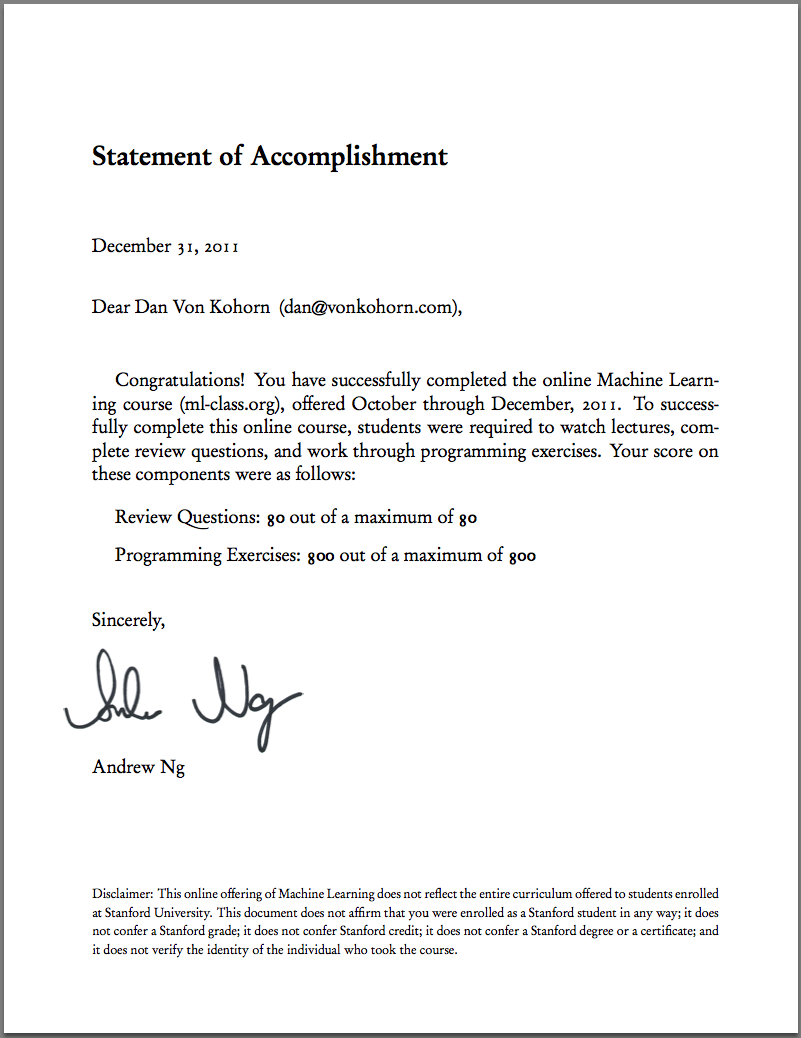
Over 12k students received a 'statement of accomplishment' from Ng’s Fall 2011 course.
Over 100,000 students signed up for his free, fall 2011 course on machine learning. The impacts were huge. Over 12% of the students completed the course, and received a statement of accomplishment. Ng says he “heard many stories from students about how they’re using it at work, about how it’s inspired them to go back to school, and so on.” In contrast, Ng’s normal, for-credit course at Stanford, one of the most popular on campus, would enroll 350 students.
It’s part of a new revolution in higher education, and it’s serious learning. They deliver complete courses where students are not only watching web-based lectures, but also actively participating, doing exercises, and deeply learning the material. Students are expected to devote ~12 hours a week to the course, to read and watch course materials, complete assignments, and take quizzes and an exam.  Online students did not receive one-on-one interaction with professors, the full content of lectures, or a Stanford degree — those who completed the course received a statement of accomplishment. Course materials include prerecorded lectures (with in-video quizzes) and demos, multiple-choice quiz assignments, automatically-checked programming exercises with an interactive workbench, midterm and final exams, a discussion forum, optional additional exercises with solutions, and pointers to readings and resources.
Online courses can be a great way to teach (and learn) new skills. They can be small and highly personal, or scale to thousands of students. As followup to my post about “What is an online course?”, let’s look behind the scenes at a few kinds of successful online classes, rich with video, feedback and large amounts of real-world work.
Structuring a course
 The Museum of Modern Art (MoMA) currently has six 8 or 10 week online courses. The cost is $200 for self-guided courses, or $350 for instructor-led. The latter enroll 30-45 students. MoMA offers both knowledge classes, e.g., “Modern and Contemporary Art: 1945–1989,” and knowledge/skill courses, e.g., “Materials and Techniques of Postwar Abstract Painting,” in which students do hands-on work at home.
The instructor-led classes offer structure, socialization and personalization; whereas, the self-guided courses are about individual freedom, providing access to curated articles and video, with no live instructor facilitation nor social interaction with other students.
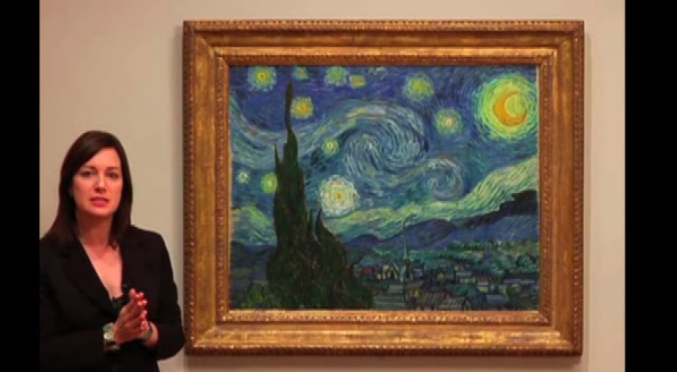 The studio-art offerings have weekly assignments. For example, students paint canvases using the materials and techniques of iconic artists. They photograph their works in progress and finished, and upload them to discuss with other students and the instructor. Wendy Woon directs MoMA’s education department. She feels the 10-week timeframe has worked well for studio art, allowing enough time for a sense of trust and community to develop in the discussion forums so that students are willing to have “critical conversations” criticizing each other’s work.
“The debate about which is better, face-to-face learning or online learning is fast becoming obsolete,” says Jennifer Berghage, an instructional designer at Pennsylvania State University. The common goal is that “an online course should be, above all, engaging, so that the learner enjoys the learning and is able to not only assimilate it but retain it and apply it.”
Online courses are revolutionizing formal education, and have opened a new genre of outreach on cultural and scientific topics. These courses deliver a series of lessons to a web browser or mobile device, to be conveniently accessed anytime, anyplace. (more…)
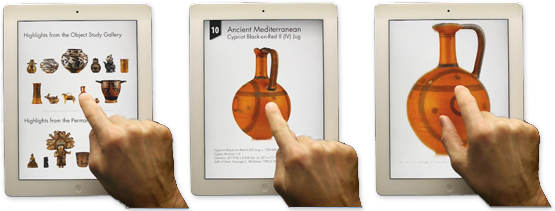
 A Hopi doll with painted headdress springs to life, spinning under my finger tips on a new iPad app from the University of Virginia Art Museum (UVaM).
The delightful app presents 19 different objects in 3D, to spin and zoom, providing an immediacy that rivals seeing an object in real life. In fact, it’s better in many ways than peering at an object through a protective case because the objects can be spun through a full 360°, view under bright lighting, at high resolution.
Personal exploration
The free app presents the mobile visitor with a grid of objects (below, left):
Last weekend, IDEA’s SpicyNodes project received a “Best Websites for Teaching and Learning” from American Association of School Librarians (AASL), a division of the American Library Association (ALA). Here’s a three minute video of our acceptance speech from the conference… (more…)