

There are gender wars, and then there are casualties. It wasn’t until 2011 that the behemoth toymaker LEGO acknowledged girls’ desire to build with bricks, even though the company had long before made a seemingly effortless pivot to co-branding, video games, and major motion pictures. So it’s little wonder that girls face all-too-real obstacles when […]
Read moreCategory: Interactive experiences
 Swirling a tasting of beer in my plastic glass, I was curiously intrigued by the presenter’s explanations about Trappist monks breaking off from the Cistercian order, the impacts of iso-amyl acetate (banana) and ethyl hexanoate (green apple) on flavor, and how dealing with soft water led to curious additions to beer, like oysters and seawater. (more…)

IDEA’s second mobile app, WikiNodes (see app store link) puts the encyclopedic knowledge of Wikipedia at the fingertips of iPad users. Articles are displayed as nodes that can be touched, dragged and spun around — showing the relations between articles and sections of articles. The app is currently featured in Apple’s app store.
Here’s a 30 second demo:
The app is based on IDEA’s SpicyNodes system for displaying and navigating information using nodes (see SpicyNodes.org). The SpicyNodes approach has great potential for other subjects, from browsing museum collections and archives, to browsing flora & fauna, and many other kinds of linked data.
 “This is your target” the game says, pointing at an ordinary looking cartoon woman in a T-shirt and track pants. “If you pay close attention to the host’s weaknesses, you can make a disease that will get the host super duper sick!” (more…)
 Games on mobile devices are a new way to engage museum visitors. Two companies gave presentations at yesterday’s Museums & Mobile 2011 online conference.
One popular type of game is a miniature scavenger hunt, called “location-gaming.” The premise is that players go places (e.g., a restaurant or park), do fast, simple tasks (like typing something into their phone, or uploading a photo of something), and win a reward (the reward can virtual “points,” or something tangible, like a free postcard or sandwich). Other types of games are more thematic, such as creating playing-card “battles” between characters that appear in art. (more…)
 Museums are going mobile, and many companies are eager to help. At yesterday’s Museums & Mobile 2011 online conference, several vendors promoted their wares. This is a summary of products, approaches, and some alternatives… (more…)
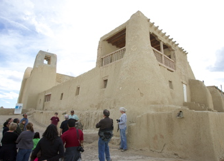 Walking over rough sandstone blocks, between adobe houses, our $20/person tour wove through the streets and alleys of a small village atop a mesa in the Acoma Pueblo, in New Mexico.
The tour culminated in the local church (at right), the San Esteban del Rey Mission, which is a source of great pride, and also a symbol of Catholic persecution of traditional peoples. The earthen walls are many feet thick, and the roof is supported by centuries-old logs. (more…)
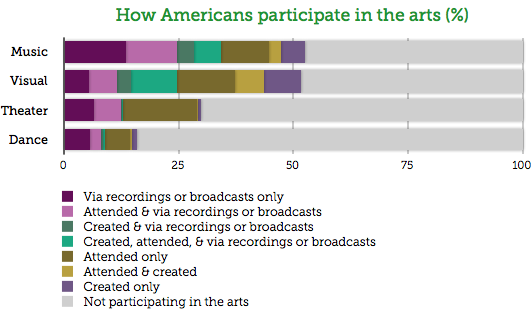
Computers and the internet are an increasingly important way that Americans engage in the arts, says a new report from the National Endowment for the Arts. The first bar in the chart below is people consuming recorded or broadcast content:
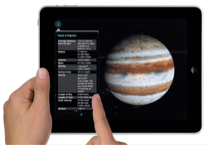 On the screens of millions of iPad and other mobile devices, moons and stars, elements and molecules swirl beneath our fingertips. Developer Mike Howard says he wants to “make you feel like you are actually there in orbit.” Theodore Gray wants you to look at the periodic table and be transported to the world of Harry Potter, feeling as “if you checked out a magical version of The Elements from the Hogwarts library.”
Apps represent a shift in how students and the public learn about science. Currently, the best science apps are not being created by museums, traditional publishers, or curriculum developers — They are being created by enthusiastic solo developers, research centers, and new software companies with a penchant for science and public education. We’ll look at what motivated these app creators, what it took to make the apps, and how successful they have been. (more…)

Real life has a close competitor in the “Art Project,” released by Google last week. Their initial release is a clean, inviting site for browsing over one thousand artworks from 17 of the world’s most famous museums. At least one piece from each of the 17 museums is displayed in gigapixel resolution, so that online visitors can zoom in to the brushstrokes. Each piece also has information about the artists, text or video commentary, bios, and links to related pieces. Some museums have 3D walk-throughs, analogous to Google’s map street views (there are 6000 3D panoramas), and there’s a way to create personal art “collections” to revisit or share later.
IDEA presented and demonstrated “Concept Maps for Online Exhibits” at the 2010 Museums and the Web Conference, April 13-17 in Denver. Concept maps are a useful component of online exhibits, as they help meet the needs of multiple learning styles and provide an innovative way to visualize information. SpicyNodes’ radial mapping engine improves upon previous