

Community Embraces New Word Game at Mid-Year Play Day This past Sunday, families at Takoma Park’s Seventh Annual Mid-Year Play Day had the opportunity to experience OtherWordly for the first time. Our educational language game drew curious children and parents to our table throughout the afternoon. Words in Space Several children gathered around our iPads […]
Read more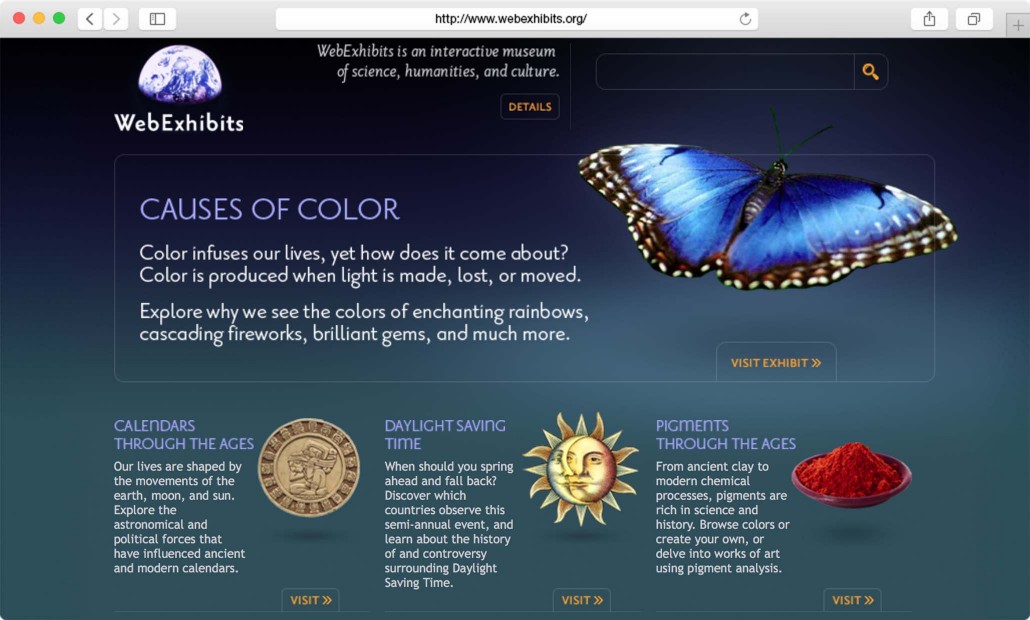
Launched in 1999, IDEA’s WebExhibits was a trailblazer in online museums. At the time of WebExhibits’ inception, interactive virtual exhibits were relatively unknown to institutions whose core competencies lay in managing brick and mortar operations and whose revenue models emphasized ticketed attendance and donors. With more than 110 million visitors, IDEA’s virtual museum helped pave the way for physical museums to extend their reach and increase their impact by embracing online exhibits. More than half a million visitors each spent over half an hour immersed in our exhibits, and more than 5 million spent over 10 minutes.
WebExhibits did more than lead by example. IDEA also published critical information about why online exhibits are a good investment, how they address the educational needs of a broader audience, and how to create a virtual exhibit.
WebExhibits tapped into experts’ knowledge and early 21st century technological potential to create a rich, immersive experience that incorporates narratives, descriptions, maps, photos, video, and audio. This information, along with interactive virtual experiments and hands-on activities, prompts visitors to think, to formulate questions, and to explore topics from a variety of angles.
The National Education Association recommended WebExhibits’ exhibitions as good tools and ideas for teacher lesson plans, surveying “Science & Art of Perspective,” “Causes of Color,” and “Poetry through the Ages.”
Our work developing WebExhibits, and writing about it, would go on to be cited by academics. In her dissertation, Planning, Developing, and Evaluating eMuseums: Step-By-Step Handbook for Museum Professionals, Tara Jean Baillargeon referenced our article, “Interactivity Techniques: Practical Suggestions for Interactive Science Websites” as a source.
WebExhibits consists of 10 interactive, online exhibitions that cover science, technology, engineering, mathematics, humanities, and cultural topics:
Causes of Color: Shedding light on the age-old question, “Why is the sky blue?”, this exhibit enables visitors to explore the scientific origins of color, including the relevance of vibrations, gas excitations, diffraction, and energy bands.
Color Vision and Art: Exploring the relationships between modern art and the science of color and human vision, this exhibit uses artwork and its historical context to explain what we see and why we see it in a certain way. Other topics include color interactions, peripheral vision, luminance, and equiluminance. This exhibit was cited by the Las Vegas Review-Journal for informing readers about the history of the color red.
Calendars through the Ages: Calendars may seem mundane, but they have a fascinating backstory. This exhibit explores the rich histories of a variety of calendars, the mathematics behind calculating days, weeks, months, and years, and why we organize our lives in accordance with the sun and the moon.
This exhibit was approved as a learning resource by the Los Angeles Times‘ Education Page alongside PBS, National Geographic, and several academic and government resources.
On December 28, 2000, NASA Kids recommended “Calendars through the Ages,” adding it to an article discussing the history of the calendar and the passage of time.
Daylight Saving Time: While the adoption of Daylight Saving Time is almost always rife with controversy, most of the world has implemented it. This exhibit explores the standardization of time and the origins of Daylight Saving Time, while providing up-to-date information on if and when countries around the globe observe it.
Writing for the National Review, Lawrence W. Reed of the Mackinac Center for Public Policy cited IDEA’s work in a discussion of the history of time.
This exhibit was also cited as a learning resource by the Los Angeles Times Education Page and was recommended by the New York Times as a source of information explaining the history of Daylight Saving Time. On March 9, 2007, it was mentioned in the Washington Post‘s Going Out Guide, in which writer Caroline Kettlewell cited WebExhibits as a source of “a host of interesting facts about DST.”
Poetry through the Ages: Tracing the origins of European poetry from its ancient Greek roots and its evolution through history to modern times, this exhibit is designed to move poetry into the mainstream. With an interactive tour and multimedia content, the exhibit explains both the history and mechanics of 18 poetry forms, and gives visitors “recipes” so that they can write their own poetry.
Investigating Bellini’s Feast of the Gods: Early in the 16th century, Giovanni Bellini painted the Italian Renaissance masterpiece “The Feast of the Gods.” However, 10 years later, the renowned Titian painted over the masterpiece. Using innovative data display techniques, this exhibit explains the scientific analyses conducted by the National Gallery of Art. (A version of the exhibit was produced in Spanish for the Prado in Madrid.)
Another wonderful, inclusive site is WebExhibits where great details are given about the investigation of this painting.– CS Judd, Journal of Chemical Education,
2001
Van Gogh’s Letters: On December 13, 1872, Vincent van Gogh (1853-1890) wrote to his brother Theo, “…We must be sure to write to each other regularly…” Over the next two decades, hundreds of letters were shared between the brothers and with others, giving us an unparalleled record of the artist’s creative and spiritual life. This exhibit enables visitors to explore that inner life.
Interestingly, this will not be the first Web site to offer access to van Gogh’s letters. A site maintained by WebExhibits, and funded with a grant from the U.S. Department of Education, has all of the artist’s letters that were included in the old English edition.– Kate Taylor, the New York Sun,
August 21, 2007
Pigments through the Ages: This exhibit explores the historical origins and the science of color pigments, in rich detail and with the aid of beautiful imagery. Visitors are treated to an interactive explanation of how paintings are created using myriad colors and types of paint.
Family Tree of the Greek Gods: This interactive genealogic map employs radial mapping and an exploratory user interface that invites visitors to learn about the gods and goddesses who brought order and meaning to the universe of the ancient Greeks.
Butter: Visitors to this virtual exhibit can explore the historical origins, composition, science, and uses of this wonderfully smooth, rich indulgence.