

Community Embraces New Word Game at Mid-Year Play Day This past Sunday, families at Takoma Park’s Seventh Annual Mid-Year Play Day had the opportunity to experience OtherWordly for the first time. Our educational language game drew curious children and parents to our table throughout the afternoon. Words in Space Several children gathered around our iPads […]
Read moreHow words connect through meaning
76%
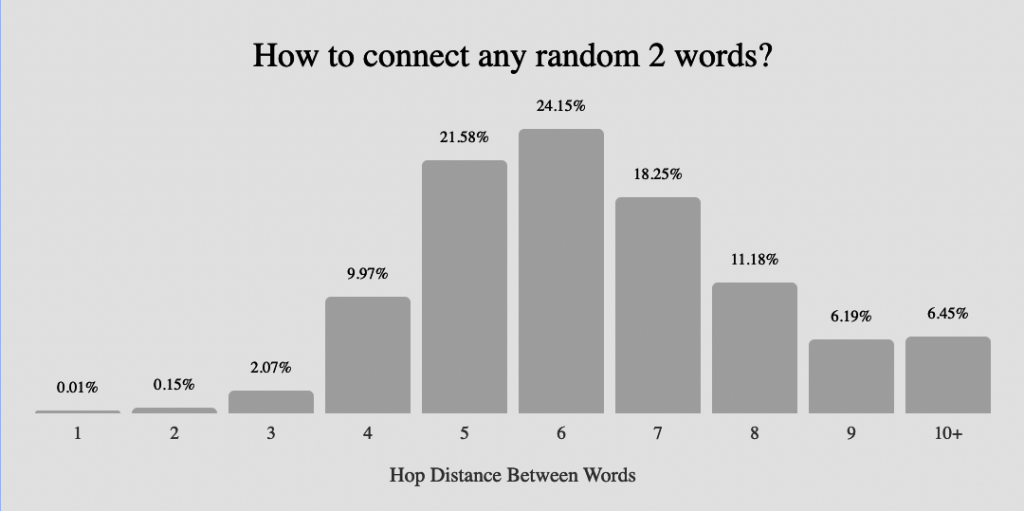
of random English word pairs connect in 7 hops or fewer
Our most significant finding from the Linguabase: English exhibits a “small world” property. Nearly any two words connect through chains of meaning—a mathematical property that makes our games possible.
The Finding
Analyzing the Linguabase’s 1.5 million words and 100 million relationships, we discovered that 76% of random English word pairs connect in seven hops or fewer, with an average path length of just 6.43 steps.
This explains why players can intuitively navigate from “Batman” to “inspect” through meaningful connections:
Batman → vigilante → watchful → circumspect → inspect
Or from “sugar” to “peace”:
sugar → sweet → harmony → peace
Why It Matters
The small world property of language means that semantic navigation is learnable. Players don’t need extensive vocabulary to find paths—they need lateral thinking. The network’s structure ensures that intuitive connections exist between almost any two concepts.
This finding is foundational to both In Other Words (pathfinding between distant ideas) and OtherWordly (matching words by semantic similarity).
Multiple Meanings as Network Bridges
English words often carry multiple meanings, creating natural bridges in the network:
- Homographs — Identical spelling, different meanings: “bass” (sound) vs. “bass” (fish). English has 1,000–3,000 of these.
- Polysemes — Multiple related definitions from the same root: “head” as body part, leader, or ship’s bow.
- Contextual flavors — Same core meaning, different associations: “hiking” can emphasize nature (scenery, trails) or exercise (fitness, exertion).
These multi-sense words offer creative routing options. Analysis of 31,387 homograph-containing paths showed they don’t create shortcuts—they provide alternative paths through semantic space.
Comparison to Other Small Worlds
The “small world” phenomenon appears in many networks:
- Social networks — “Six degrees of separation” (avg. 6 connections between any two people)
- Wikipedia — Any two articles connect in about 4.5 clicks
- The Linguabase — 6.43 average path length between random word pairs
Language’s small world property may reflect how human cognition organizes concepts—or it may emerge from the structure of the world itself, where ideas cluster around shared properties and functions.