

Community Embraces New Word Game at Mid-Year Play Day This past Sunday, families at Takoma Park’s Seventh Annual Mid-Year Play Day had the opportunity to experience OtherWordly for the first time. Our educational language game drew curious children and parents to our table throughout the afternoon. Words in Space Several children gathered around our iPads […]
Read moreMonth: July 2011
 Cloud computing is a metaphorical term for hosted services on the Internet. This can be infrastructure (i.e., raw equipment), platforms (e.g., operating systems, basic software like databases or web servers), or software (e.g., content managements systems, social networking software). Typically, it is sold on metered basis, like a utility charges for water.
 When deciding what software to use for a project, how do you decide on open source vs. proprietary software? For example, in prior post on social networking software, there are some free options (assuming you have a developers on hand), and some expensive options. Here’s a summary of the typical pros and cons for Open Source. (more…)
 So you want to create a niche social network? And you’ve read the prior post on overall issues to consider? Here’s an overview of over a dozen software platforms you might consider. (more…)
 Social networking gives professionals and enthusiastic members of the public a great way to connect and share information about scientific or cultural topics.
A niche social network can benefit small, grassroots projects as well as large institutions, achieving many objectives simultaneously. A social network allows members to e.g., exchanging information, making personal connections, fostering dialog and awareness on a topic, as well as fundraising or promoting products and services.
Here are some tips and considerations for getting started… (more…)
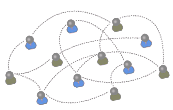 Thinking about launching a new niche social network for a science or cultural community of professionals? Think again. It costs a lot to do well, and there’s a major risk of failure. People don’t have much time to spend logging into yet another social network, and it’s hard to reach a critical mass so that the site is interesting for people to use.
On the other hand, many niche communities still lack a good way to interact online. So there’s a potential need for new social networks.
 Ravelry
Ravelry.com (for knitters and crocheters) is a fantastic example of a thriving niche social network. It has over 1.4 million members (and my wife loves it: she spends more time in there than on Twitter or Facebook). A recent article about Ravelry in Slate talks about how “social sites work better when they’re smaller and bespoke, created to cater to a specific group.” Members share photos and swap tips on their knitting projects. The site was started by a husband & wife team, and now has a 4-person staff. Revenue comes from their online store and advertisers. (more…)